October 1st 1996 - Rover Press Release
Page 1 - Overview
RADICAL CHANGE OF DIRECTION FOR MINI
Announced on the 1st of October 1996, the most radical package of improvements in its history brought a new direction for one of the world's best-loved cars - the Mini. Making its debut at the Paris Motor Show, the latest Mini range sees greater emphasis than ever on its unique personality, enhancing its status as something far more than another small car.
Announced on the 1st of October 1996, the most radical package of improvements in its history brought a new direction for one of the world's best-loved cars - the Mini. Making its debut at the Paris Motor Show, the latest Mini range sees greater emphasis than ever on its unique personality, enhancing its status as something far more than another small car.
The current line-up of just two models - Mini and Mini Cooper - offers significantly improved specification levels and extensive engineering changes. They provide not only greater technical refinement, but the most comprehensive opportunity ever for Mini buyers to individualise their car and to create a vehicle that transcends conventional boundaries.
EXTENSIVE RE-ENGINEERING
Elevating the Mini from its traditional 'entry-level' positioning, the changes that have created the new range incorporate a wide spectrum of actions to refine all aspects of the car's performance. It includes a comprehensive new safety package which includes a driver's airbag - a feature once thought impossible to engineer into Mini.
Stringent new emissions legislation and pass-by noise regulations have not simply been met, but exceeded by significant investment in the power train and its installation. Multi-point fuel injection, using two injectors carefully tuned to the A-series siamesed inlet port design, are controlled by the sophisticated MEMS 2J electronic engine management system used on Rover's 800 KV6 and MGF 1.8i VVC. Power output remains unchanged but a much improved torque curve has enabled the introduction of a higher final-drive ratio for more relaxed cruising at motorway speeds.
Another significant technical change is the repositioning of the radiator to the front of the engine bay ensuring compliance with the pass-by noise legislation and enabling major gains in refinement at all engine and road speeds.
NEW SAFETY PACKAGE
The complex engineering task has included the installation of competitive levels of secondary safety equipment. A driver's airbag is now fitted as standard and seat belt pre-tensioners and side door intrusion beams are part of the core specification on both models. The airbag has required a total re-design of the steering column enabling the fitment of up-to-date column control stalks which finally bring the lighting controls to within finger-tip control of the driver.
FOLLOWING FASHION
Mini buyers and established owners alike spend considerable sums on options and accessories. As a means of fashionable self expression, Mini is unsurpassed - rarely are two exactly the same. The 1997 Mini programme allows the customer to choose a wide range of unique colours, trims, options and accessories enabling the car to truly reflect the owner's personality. Factory fit options include a Sports Pack featuring stunning 13" x 6J alloy wheels, with body coloured wheel arch spats and Koni shock absorbers, along with additional instrumentation, lamps and a big-bore chrome exhaust finisher. Leather trim, finished in a style reminiscent of much more expensive cars, is available in a range of colours including a red leather 'classic' style evocative of the 1960s. Several 'original' body colours are available including Almond Green and Surf Blue. A 10-piece wood kit, 'turned alloy' facia and electric canvas sun-roof complete the factory fit option line-up.
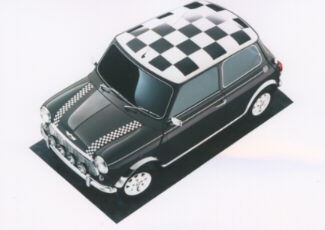
The most extensive customisation opportunity comes from the immense range of accessories now available to Mini owners old and new. Every conceivable area is covered from road wheels to exterior chrome details, interior leather and alloy finished items, wood door cappings and even a polished engine rocker cover. Dramatic effects are available through a range of decal kits including the "Union Jack" and "Chequered" roofs, a 'zipper' full length side decal and a range of additional badges.
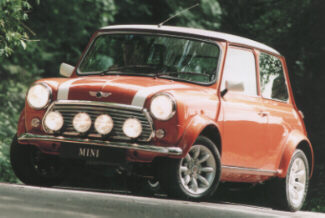
Mini is priced at £9325 and Mini Cooper is priced at £9625 (although you should expect a generous discount) and both are powered by the 63PS A-Series engine. Alloy wheels are standard on both derivatives with a new 'luxury' design featuring on the Mini. A wood facia with additional instrumentation applies to both models and the Mini Cooper retains its white roof, bonnet stripes and spoked alloy wheel design.
WHO BUYS A MINI?
Throughout the 1990s, Mini has been moving steadily upmarket. In the key export markets of Europe and Japan, Mini has long been perceived as a desirable status symbol, bought for its heritage and unique, ageless style. The 1997 programme moves the UK versions of the car in this same direction, as there are no longer any 'entry-level' models such as the previous Sprite or low price Special Editions.
Typical Mini buyers are now less likely to be families seeking a second or third car, but increasingly tend to be single, well-educated professional and managerial people desiring a fashion statement.
The 1997 Mini sees an important step-change in the development and projection of the Mini brand by reverting to a classically simple and straightforward range that emphasises the strength of the brand, taking it firmly upmarket.
EXTENSIVE RE-ENGINEERING
Elevating the Mini from its traditional 'entry-level' positioning, the changes that have created the new range incorporate a wide spectrum of actions to refine all aspects of the car's performance. It includes a comprehensive new safety package which includes a driver's airbag - a feature once thought impossible to engineer into Mini.
Stringent new emissions legislation and pass-by noise regulations have not simply been met, but exceeded by significant investment in the power train and its installation. Multi-point fuel injection, using two injectors carefully tuned to the A-series siamesed inlet port design, are controlled by the sophisticated MEMS 2J electronic engine management system used on Rover's 800 KV6 and MGF 1.8i VVC. Power output remains unchanged but a much improved torque curve has enabled the introduction of a higher final-drive ratio for more relaxed cruising at motorway speeds.
Another significant technical change is the repositioning of the radiator to the front of the engine bay ensuring compliance with the pass-by noise legislation and enabling major gains in refinement at all engine and road speeds.
NEW SAFETY PACKAGE
The complex engineering task has included the installation of competitive levels of secondary safety equipment. A driver's airbag is now fitted as standard and seat belt pre-tensioners and side door intrusion beams are part of the core specification on both models. The airbag has required a total re-design of the steering column enabling the fitment of up-to-date column control stalks which finally bring the lighting controls to within finger-tip control of the driver.
FOLLOWING FASHION
Mini buyers and established owners alike spend considerable sums on options and accessories. As a means of fashionable self expression, Mini is unsurpassed - rarely are two exactly the same. The 1997 Mini programme allows the customer to choose a wide range of unique colours, trims, options and accessories enabling the car to truly reflect the owner's personality. Factory fit options include a Sports Pack featuring stunning 13" x 6J alloy wheels, with body coloured wheel arch spats and Koni shock absorbers, along with additional instrumentation, lamps and a big-bore chrome exhaust finisher. Leather trim, finished in a style reminiscent of much more expensive cars, is available in a range of colours including a red leather 'classic' style evocative of the 1960s. Several 'original' body colours are available including Almond Green and Surf Blue. A 10-piece wood kit, 'turned alloy' facia and electric canvas sun-roof complete the factory fit option line-up.
The most extensive customisation opportunity comes from the immense range of accessories now available to Mini owners old and new. Every conceivable area is covered from road wheels to exterior chrome details, interior leather and alloy finished items, wood door cappings and even a polished engine rocker cover. Dramatic effects are available through a range of decal kits including the "Union Jack" and "Chequered" roofs, a 'zipper' full length side decal and a range of additional badges.
Mini is priced at £9325 and Mini Cooper is priced at £9625 (although you should expect a generous discount) and both are powered by the 63PS A-Series engine. Alloy wheels are standard on both derivatives with a new 'luxury' design featuring on the Mini. A wood facia with additional instrumentation applies to both models and the Mini Cooper retains its white roof, bonnet stripes and spoked alloy wheel design.
WHO BUYS A MINI?
Throughout the 1990s, Mini has been moving steadily upmarket. In the key export markets of Europe and Japan, Mini has long been perceived as a desirable status symbol, bought for its heritage and unique, ageless style. The 1997 programme moves the UK versions of the car in this same direction, as there are no longer any 'entry-level' models such as the previous Sprite or low price Special Editions.
Typical Mini buyers are now less likely to be families seeking a second or third car, but increasingly tend to be single, well-educated professional and managerial people desiring a fashion statement.
The 1997 Mini sees an important step-change in the development and projection of the Mini brand by reverting to a classically simple and straightforward range that emphasises the strength of the brand, taking it firmly upmarket.
There are just two models - the Mini and Mini Cooper.
Both feature impressive new specification enhancements, including new safety and refinement packages.
Both have the latest 63PS multi-point injection power unit and all the associated technical improvements.
Both are available with a newly-created array of quality approved options and accessories - with a dramatic 'Sports Pack' for the ultimate in street style.
Both are priced identically in standard form - customers simply choose the imagery that they prefer.
Both feature impressive new specification enhancements, including new safety and refinement packages.
Both have the latest 63PS multi-point injection power unit and all the associated technical improvements.
Both are available with a newly-created array of quality approved options and accessories - with a dramatic 'Sports Pack' for the ultimate in street style.
Both are priced identically in standard form - customers simply choose the imagery that they prefer.
Page 2 - Rover Mini - Product in Detail
ENGINE AND TRANSMISSION
Mini was designed in an era when legislation was scarcely more than compliance with Construction and Use Regulations; its 'A' Series engine had been designed even earlier. It is a tribute to all engineers involved then and now that the 1997 Mini has been able to meet the very demanding 'ECDII' emissions standards in addition to the new pass-by noise requirements. Significant engineering changes have been made to achieve these environmental standards, making the 1997 cars the most technically sophisticated production Minis ever.
The major change to the 1275cc Cooper engine, now standardised in both 1997 models, has been the adoption of multi-point fuel injection. The system is controlled by Rover's most powerful engine management computer, the MEMS 2J, (as developed for the 2.5 litre KV6 and the MGF 1.8i VVC engines) to give fully programmed sequential injection. Each injector is pulsed at the optimum time to independently fuel the two cylinders that it serves. This provides the ultra-precise control of fuel input and distribution needed to achieve very low emissions, whilst at the same time maintaining excellent performance.
Another contributory state-of-the-art feature is the fitment of a direct (distributorless) electronic ignition system. This uses quad dry-coil twin-spark technology, triggering each spark twice - once on the compression stroke and once on the exhaust stroke - so that the high tension voltage does not have to be switched between cylinders. The cylinder block has been modified to delete the distributor housing, redesign the oil galleries and also to re-locate the oil filter (deleting the external pipework). This has allowed the radiator to be moved from its traditional side mounting to a more conventional position in front of the engine as part of the pass-by noise reduction programme. Other technical improvements under the bonnet include the replacement of the former 45 amp alternator with a 65 amp unit and the use of a modern poly-vee belt alternator/water pump drive for greater durability and reliability.
PERFORMANCE AND ECONOMY
Despite being the 'cleanest' 'A' Series engine yet, the 1997 Mini engine matches the power and torque figures of the previous Cooper unit, doing so at lower engine speeds. For lower internal noise levels, a 2.76:1 final drive ratio raises the overall gearing by 16% compared to the previous Mini Cooper and this, coupled with an inevitable weight increase of around 3.5%, means a slight reduction in 'on paper' performance. The figures, however, remain very competitive and the subjective impression of the power delivery is excellent.
With fourth gear now equivalent to fifth gear on many other cars and a third gear high enough to virtually achieve the 90mph maximum speed, the driving characteristics are very different. The 'overdrive' fourth gear cuts engine speed at 70mph from 3,888 rpm to 3,333 rpm for more comfortable cruising, while third gear now provides the upper range acceleration and overtaking capability.
As a result of the significant power unit modifications, automatic transmission is no longer available.
Fuel Consumption
In common with all models homologated since January 1st 1996, the 1997 Minis must, by law, have their official fuel consumption figures stated in the new 93/116/EC standard format. This is comprised of a new 'Urban' cycle, which now includes a cold start, a new 'Extra Urban' (meaning 'out of town') cycle and a 'Combined' urban/extra urban figure which is an average of the two figures weighted by the distance covered in each cycle.
It must be stressed that the new figures cannot be compared in any way with the previous Urban/56mph/75mph figures, or any of their various 'composite' and 'Euromix' derivatives.
The new tests are completely different and are intended to give a more realistic representation of normal car use. As before, however, they still only form the basis for comparison between different cars, as no standard test can possibly tell a given customer what fuel consumption he or she will achieve.
The fuel economy figures for the 1997 Minis are as follows:
SAFETY AND SECURITY
Sector leading Safety
In keeping with the enhanced specifications of the 1997 Minis, a comprehensive new safety package has been standardised. This includes:
This now aligns the secondary safety features of Mini with those of many much larger vehicles and moves it ahead of many other cars in its size sector.
Anti-theft measures
In 1997 form, the Mini and Mini Cooper are even more desirable - so it is re-assuring that the standard security system is comprehensive. There is a full perimetric alarm system, plus an engine immobiliser, operated by a remote control. Even if the owner forgets or delays the setting of the system, the engine immobiliser will automatically activate after a few seconds to foil the opportunist thief. A facia warning light flashes once the system is activated to deter unwelcome attention.
REFINEMENT
Mini moves into a new and quieter age with the 1997 models. By combining engineering changes that meet stringent new 'pass-by' noise regulations with substantial improvements to cabin acoustic insulation, the latest Minis have become the most civilised yet.
The EC directive on pass-by noise (92/97/EEC) that all post-October 1996 registered cars must meet, demands a maximum of 74dB(A) measured by a special test procedure. Since the previous limit was 77dB(A), this may not seem a big reduction, but because decibels are plotted on a logarithmic scale, it actually represents a halving of the noise level. Reductions of up to 3dB(A) in the critical 3250-3500 rpm range mean that motorway cruising at the legal speed limit is twice as quiet!
In order to achieve this, the 1997 Minis feature higher gearing, a new front-mounted radiator with electric cooling fan, and a rear exhaust silencer box.
Interior sound deadening measures include damping pads in the roof, plus the extra absorption effect of the new foam-backed fabric headlining which help to tune out the 'boom' effect at higher engine speeds. Extra sound-path sealing around the top of the bulkhead and the A-post areas keeps engine noise out and there is new sound insulation around the fuel tank and boot area to eliminate any possibility of whine from the high pressure fuel pump. The rear seat bulkhead is now solid, without the former blanked-off central aperture. Improved acoustic insulation from road noise results from the new moulded one-piece floor carpet.
Mini was designed in an era when legislation was scarcely more than compliance with Construction and Use Regulations; its 'A' Series engine had been designed even earlier. It is a tribute to all engineers involved then and now that the 1997 Mini has been able to meet the very demanding 'ECDII' emissions standards in addition to the new pass-by noise requirements. Significant engineering changes have been made to achieve these environmental standards, making the 1997 cars the most technically sophisticated production Minis ever.
The major change to the 1275cc Cooper engine, now standardised in both 1997 models, has been the adoption of multi-point fuel injection. The system is controlled by Rover's most powerful engine management computer, the MEMS 2J, (as developed for the 2.5 litre KV6 and the MGF 1.8i VVC engines) to give fully programmed sequential injection. Each injector is pulsed at the optimum time to independently fuel the two cylinders that it serves. This provides the ultra-precise control of fuel input and distribution needed to achieve very low emissions, whilst at the same time maintaining excellent performance.
Another contributory state-of-the-art feature is the fitment of a direct (distributorless) electronic ignition system. This uses quad dry-coil twin-spark technology, triggering each spark twice - once on the compression stroke and once on the exhaust stroke - so that the high tension voltage does not have to be switched between cylinders. The cylinder block has been modified to delete the distributor housing, redesign the oil galleries and also to re-locate the oil filter (deleting the external pipework). This has allowed the radiator to be moved from its traditional side mounting to a more conventional position in front of the engine as part of the pass-by noise reduction programme. Other technical improvements under the bonnet include the replacement of the former 45 amp alternator with a 65 amp unit and the use of a modern poly-vee belt alternator/water pump drive for greater durability and reliability.
PERFORMANCE AND ECONOMY
Despite being the 'cleanest' 'A' Series engine yet, the 1997 Mini engine matches the power and torque figures of the previous Cooper unit, doing so at lower engine speeds. For lower internal noise levels, a 2.76:1 final drive ratio raises the overall gearing by 16% compared to the previous Mini Cooper and this, coupled with an inevitable weight increase of around 3.5%, means a slight reduction in 'on paper' performance. The figures, however, remain very competitive and the subjective impression of the power delivery is excellent.
With fourth gear now equivalent to fifth gear on many other cars and a third gear high enough to virtually achieve the 90mph maximum speed, the driving characteristics are very different. The 'overdrive' fourth gear cuts engine speed at 70mph from 3,888 rpm to 3,333 rpm for more comfortable cruising, while third gear now provides the upper range acceleration and overtaking capability.
As a result of the significant power unit modifications, automatic transmission is no longer available.
Fuel Consumption
In common with all models homologated since January 1st 1996, the 1997 Minis must, by law, have their official fuel consumption figures stated in the new 93/116/EC standard format. This is comprised of a new 'Urban' cycle, which now includes a cold start, a new 'Extra Urban' (meaning 'out of town') cycle and a 'Combined' urban/extra urban figure which is an average of the two figures weighted by the distance covered in each cycle.
It must be stressed that the new figures cannot be compared in any way with the previous Urban/56mph/75mph figures, or any of their various 'composite' and 'Euromix' derivatives.
The new tests are completely different and are intended to give a more realistic representation of normal car use. As before, however, they still only form the basis for comparison between different cars, as no standard test can possibly tell a given customer what fuel consumption he or she will achieve.
The fuel economy figures for the 1997 Minis are as follows:
- Urban 33.4 mpg (8.5 l/100 km)
- Extra- Urban 51.8 mpg (5.5 l/100 km)
- Combined 43.0 mpg (6.6 l/100 km)
SAFETY AND SECURITY
Sector leading Safety
In keeping with the enhanced specifications of the 1997 Minis, a comprehensive new safety package has been standardised. This includes:
- Driver's airbag-equipped steering wheel, fitted to a specially strengthened and newly engineered steering column.
- Front seat belt pre-tensioners (actuated by pyrotechnic devices in the inertia reel units)
- Side impact protective bars within the doors
This now aligns the secondary safety features of Mini with those of many much larger vehicles and moves it ahead of many other cars in its size sector.
Anti-theft measures
In 1997 form, the Mini and Mini Cooper are even more desirable - so it is re-assuring that the standard security system is comprehensive. There is a full perimetric alarm system, plus an engine immobiliser, operated by a remote control. Even if the owner forgets or delays the setting of the system, the engine immobiliser will automatically activate after a few seconds to foil the opportunist thief. A facia warning light flashes once the system is activated to deter unwelcome attention.
REFINEMENT
Mini moves into a new and quieter age with the 1997 models. By combining engineering changes that meet stringent new 'pass-by' noise regulations with substantial improvements to cabin acoustic insulation, the latest Minis have become the most civilised yet.
The EC directive on pass-by noise (92/97/EEC) that all post-October 1996 registered cars must meet, demands a maximum of 74dB(A) measured by a special test procedure. Since the previous limit was 77dB(A), this may not seem a big reduction, but because decibels are plotted on a logarithmic scale, it actually represents a halving of the noise level. Reductions of up to 3dB(A) in the critical 3250-3500 rpm range mean that motorway cruising at the legal speed limit is twice as quiet!
In order to achieve this, the 1997 Minis feature higher gearing, a new front-mounted radiator with electric cooling fan, and a rear exhaust silencer box.
Interior sound deadening measures include damping pads in the roof, plus the extra absorption effect of the new foam-backed fabric headlining which help to tune out the 'boom' effect at higher engine speeds. Extra sound-path sealing around the top of the bulkhead and the A-post areas keeps engine noise out and there is new sound insulation around the fuel tank and boot area to eliminate any possibility of whine from the high pressure fuel pump. The rear seat bulkhead is now solid, without the former blanked-off central aperture. Improved acoustic insulation from road noise results from the new moulded one-piece floor carpet.
Page 3 - Rover Mini - Styling
STYLING AND ACCESSORIES
On the exterior, a revised badging strategy features the word 'Mini' within the traditional three-dimensional chrome 'wings' badge. A neat and stylish new roof-mounted radio aerial and a revised colour range firmly identify this Mini from its predecessors.
Cabin ambience
Taking the interior luxury theme of recent Mayfairs and Coopers even further, the latest Mini and Mini Cooper benefit from many attractive new features.
On the exterior, a revised badging strategy features the word 'Mini' within the traditional three-dimensional chrome 'wings' badge. A neat and stylish new roof-mounted radio aerial and a revised colour range firmly identify this Mini from its predecessors.
Cabin ambience
Taking the interior luxury theme of recent Mayfairs and Coopers even further, the latest Mini and Mini Cooper benefit from many attractive new features.
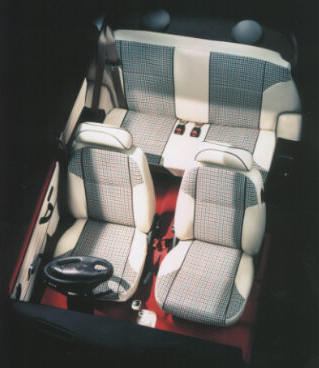
Body colour Spats for 13" wheelsSolid: Flame Red, White Diamond, Electric BlueLeather header railA new sports style steering wheel (derived from the MGF) not only looks and feels better, but brings the safety of airbag technology to the Mini for the first time. The new steering column incorporates the latest design of column stalks with both lights and wiper switching - intermittent wipe becomes a new Mini feature.
A new leather-clad gear knob and a chromed gear lever invite swift and precise ratio changes. Chrome bezels around the instrument dials evoke memories of the classic sixties.
Another two 'firsts' for the Mini are the adoption of a foam-backed cloth headlining and a new one-piece moulded floor carpet. These both heighten the quality feel of the cabin and, importantly, contribute to much-improved acoustics.
Easing access to the rear seats are new 'break-back' front seat squabs, which can be released to fold forward, in addition to offering the normal reclining adjustment. Based on the front seat design of the new Rover 200, these new squabs taper towards the top, enhancing the perception of interior spaciousness - enthusiasts will also find them reminiscent of the original 1960's Mini Cooper optional reclining seat design, with 1990's levels of comfort.
A further detail improvement that will be welcomed by owners is a new two-speed heater fan, allowing more precise control of heating and ventilation.
Moving upmarket does not make the Mini any less practical, however. There are still handy doorbins, a lidded glove box and the rear quarter bins that safely stow awkward items such as bottles or flasks. There is also a surprising amount of stowage space beneath the rear seat pan.
COMPREHENSIVE OPTION AND ACCESSORY PLAN
Sheer individuality
Mini is a car for people who spend considerable sums on 'customising'. Nowhere is this better recognised than in the new range of options and accessories now being offered with the 1997 Minis. True Mini aficionados will find this carefully chosen selection quite irresistible.
Factory options
The most radical innovation is the 'Sports Pack' - made up as follows:
13 inch ultra-sporting 6J 'Minilite Style' alloy-wheels with 175/50 R13 tyres
Special faired-in and body-coloured wheelarch spats to suit the wide tyres
Koni shock absorbers
Four front auxiliary lamps
Large bore chrome tailpipe finisher
Extra facia gauges for oil temperature and battery condition
Battery condition gauge
Oil temperature gauge
The new alloy wheels are a modern interpretation of the existing sports alloy wheel but using a wider and larger wheel size in conjunction with Koni shock absorbers to enhance the road handling.
The special wheelarch spats are not simply a 'bolt-on' fitment - they involve skilled body-in-white modification and are hand-crafted. The 13 inch wheels and ultra-low profile tyres cannot be fitted without this and other work being carried out to maintain correct clearances.
The Sports Pack creates a dramatic appearance and enhances handling and grip. The extra aerodynamic drag of the wide tyres reduces top speed to around 84 mph.
Other factory options for the 1997 Minis include:
Desirable accessories
Never have Mini buyers had such a wide array of high quality approved accessories. They can now mix and match to create their own uniquely identified Mini, following whatever theme they prefer. In total, 37 different personalising items can be specified. For example, retro enthusiasts might choose the perfect finishing touch of a 1960s-style grille to go with a 'Classic' paint and trim combination. 'Thoroughly modern' Mini buyers may choose high-tech treatment, with 'chrome' wheel arches complementing one of the special alloy wheel sets. The natural extroverts may opt for a striking decal treatment, such as the chequered roof panel. The potential is bounded only by imagination and budget, and, of course, the personalisation process can continue right through the customer's ownership of the car.
Exterior
Chrome pack 1
Chrome pack 2
Decals
Sunroofs
Wheels
Interior Pack
Alloy Pack
Wood Pack
Other interior
Engine dressing
Expanded standard range of paint colours
Colour choices from Rover's contemporary paint range rise from seven to eleven for 1997; the car wears the latest designer colours.
A new leather-clad gear knob and a chromed gear lever invite swift and precise ratio changes. Chrome bezels around the instrument dials evoke memories of the classic sixties.
Another two 'firsts' for the Mini are the adoption of a foam-backed cloth headlining and a new one-piece moulded floor carpet. These both heighten the quality feel of the cabin and, importantly, contribute to much-improved acoustics.
Easing access to the rear seats are new 'break-back' front seat squabs, which can be released to fold forward, in addition to offering the normal reclining adjustment. Based on the front seat design of the new Rover 200, these new squabs taper towards the top, enhancing the perception of interior spaciousness - enthusiasts will also find them reminiscent of the original 1960's Mini Cooper optional reclining seat design, with 1990's levels of comfort.
A further detail improvement that will be welcomed by owners is a new two-speed heater fan, allowing more precise control of heating and ventilation.
Moving upmarket does not make the Mini any less practical, however. There are still handy doorbins, a lidded glove box and the rear quarter bins that safely stow awkward items such as bottles or flasks. There is also a surprising amount of stowage space beneath the rear seat pan.
COMPREHENSIVE OPTION AND ACCESSORY PLAN
Sheer individuality
Mini is a car for people who spend considerable sums on 'customising'. Nowhere is this better recognised than in the new range of options and accessories now being offered with the 1997 Minis. True Mini aficionados will find this carefully chosen selection quite irresistible.
Factory options
The most radical innovation is the 'Sports Pack' - made up as follows:
13 inch ultra-sporting 6J 'Minilite Style' alloy-wheels with 175/50 R13 tyres
Special faired-in and body-coloured wheelarch spats to suit the wide tyres
Koni shock absorbers
Four front auxiliary lamps
Large bore chrome tailpipe finisher
Extra facia gauges for oil temperature and battery condition
Battery condition gauge
Oil temperature gauge
The new alloy wheels are a modern interpretation of the existing sports alloy wheel but using a wider and larger wheel size in conjunction with Koni shock absorbers to enhance the road handling.
The special wheelarch spats are not simply a 'bolt-on' fitment - they involve skilled body-in-white modification and are hand-crafted. The 13 inch wheels and ultra-low profile tyres cannot be fitted without this and other work being carried out to maintain correct clearances.
The Sports Pack creates a dramatic appearance and enhances handling and grip. The extra aerodynamic drag of the wide tyres reduces top speed to around 84 mph.
Other factory options for the 1997 Minis include:
- Wood veneer door cappings to complement the veneer facia
- Electric folding full-length canvas sunroof
- 'Engine-turned' alloy facia panel
- 'Cooper' Black leather trim
- 'Luxury' Beige leather trim
- Special Option 'Classic' leather trim in 'retro' 1960's Mini interior trim colours: Porcelain Green,Horizon Blue,Cumulus Grey,Tartan Red,
- Special Option 'Classic' Paint colours - again well-known favourites from the 1960s: Almond Green (as used on the Cooper 35 Special Edition),Surf Blue,Whitehall Beige,Yukon Grey
Desirable accessories
Never have Mini buyers had such a wide array of high quality approved accessories. They can now mix and match to create their own uniquely identified Mini, following whatever theme they prefer. In total, 37 different personalising items can be specified. For example, retro enthusiasts might choose the perfect finishing touch of a 1960s-style grille to go with a 'Classic' paint and trim combination. 'Thoroughly modern' Mini buyers may choose high-tech treatment, with 'chrome' wheel arches complementing one of the special alloy wheel sets. The natural extroverts may opt for a striking decal treatment, such as the chequered roof panel. The potential is bounded only by imagination and budget, and, of course, the personalisation process can continue right through the customer's ownership of the car.
Exterior
- 'Chrome' spats with chrome sill strip
- Driving lamps
- Fog lamps
Chrome pack 1
- Retro style chrome grille
- Front bumper over-riders
- Front corner nudge bars
Chrome pack 2
- Chrome wiper arms
- Chrome door mirrors
- Chrome tail-pipe finisher
Decals
- Union Jack roof decal
- Chequered roof decal
- "Zipper" side stripe decal
- Chequered bonnet stripes
- Range of additional badges
Sunroofs
- Electric powered glass sunroof
- Electric powered full-length canvas sunroof
Wheels
- 12" Sports style - Silver, Charcoal or White
- 12" Premium style
- 12" Revolution 5 spoke
- 13" Revolution 5 spoke
- 13" Sports style
Interior Pack
- Leather parcel shelf finisher
- Leather steering wheel
- Leather hand brake grip
- Leather gearknob
Alloy Pack
- Alloy door pulls
- Alloy door releases
- Alloy window winders
Wood Pack
- Wood door cappings
- Wood door pulls
- Wood door releases
- Wood window winders
Other interior
- 'Momo' alloy gearknob
- Wood gearknob
- Wood facia
- Alloy facia
Engine dressing
- Polished rocker cover
- Sump guard
Expanded standard range of paint colours
Colour choices from Rover's contemporary paint range rise from seven to eleven for 1997; the car wears the latest designer colours.
- Metallic: Charcoal, Platinum Silver, Kingfisher Blue, British Racing Green
- Pearlescent: Nightfire Red, Tahiti Blue, Amaranth( Purple), Volcano (Orange)
Page 4 - Rover Mini - Price Structure
INSURANCE RATING
The Association of British Insurers has recommended the 1997 Mini as group 5. Previously the Mayfair (with less power) was group 4. The previous Cooper (with the same power as the 1997 Minis) was at group 6. This reclassification takes account of the standard alloy wheel fitment, price, safety and performance increases to the 'standard' model.
PRICING
The value of the items necessary for the 1997 Mini to pass the emissions ECDII and pass-by noise regulations and the much increased specification does not mean a significant increase in price.
The 1997 Mini is priced on-the-road (including delivery, number plates, initial servicing and a year's road-fund licence) at:
Factory fit option pricing:
The Association of British Insurers has recommended the 1997 Mini as group 5. Previously the Mayfair (with less power) was group 4. The previous Cooper (with the same power as the 1997 Minis) was at group 6. This reclassification takes account of the standard alloy wheel fitment, price, safety and performance increases to the 'standard' model.
PRICING
The value of the items necessary for the 1997 Mini to pass the emissions ECDII and pass-by noise regulations and the much increased specification does not mean a significant increase in price.
The 1997 Mini is priced on-the-road (including delivery, number plates, initial servicing and a year's road-fund licence) at:
- Mini 1.3i £9325
- Mini Cooper 1.3i £9625
Factory fit option pricing:
- Sports Pack £795
- Power operated full-length fabric Sunroof £795
- Metallic Paint £200
- Pearlescent Paint £265
- Classic Paint Colours £265
- Beige 'Luxury' Leather (Mini only) £500
- Black 'Cooper' Leather (Cooper only) £500
- 'Classic' Leather £500
- Alloy finish facia with extra gauges £350
- Wood door and rear quarter cappings £295