Home > Ocean Liners > QE2 > Me & QE2 > Stephen Payne 2008 Lecture
Stephen Payne QE2 Lecture, December 2008
A Review and notes of Stephen Payne's excellent "Queen Elizabeth 2 : A Complete History" lecture to the joint RINA and IESIS meeting at the Mitchell Theatre, Glasgow on Tuesday the 9th of December 2008.
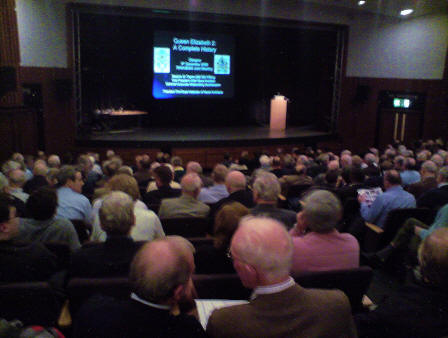
My late father had been a member of IESIS (the Institute of Engineers and Shipbuilders In Scotland) for many, many years and my Mum and I felt we should attend this talk both because we were interested in the QE2, but also because we knew Dad would have been there if he was still with us. I attended even though I had a really bad cold - something of a recurring theme for me on QE2 related activities in December! I had been wanting to ask questions and chat to people, but in the end I said nothing, much to my Mum's relief... I'm sure there were people there who would have known my Dad. There were very many grey-haired professional looking men in their 60s, 70s and 80s, reflecting the huge skill base that we had when the QE2 was being built. Lots of them reminded me of Dad - lots of Barbour jackets!
Stephen Payne was the chief naval architect of the QM2, the greatest liner in the world now that QE2 has retired, and has a great love for the QE2. Many of QM2's design features drew inspiration from the QE2 that she 'was the direct replacement for'. He is now the chief architect for Carnival cruise line, the biggest cruise line in the world.
Stephen's talk was interesting, with lots of period photos. He didn't really have time to go into much detail though, and I confess that I learned nothing new during the talk... he also didn't really express much passion, but I thought it came across more afterwards in the question and answer session.
After the talk there was a lengthy question and answer session which was fascinating. Many of the packed audience had been closely involved in the creation of the QE2 and had many interesting pearls of wisdom to share. This then drew more information from Stephen.
Although he had hardly mentioned QM2 during his talk, he was asked about it and we all learned just what a good ship she is. Having also learned that really it was indeed QE2's time to leave service it was a nice mood to leave on. I think it would be sadder indeed if QE2 had left service without the magnificent QM2 to take her place. It was quite poignant to be at this meeting as QE2 sat in Dubai, empty, lights still ablaze, the echo of the farewell parties on board just 2 weeks before still to be heard... awaiting her fate.
If Stephen ever reads this, thanks for taking the time to come to Glasgow - we all appreciated it very much! Sorry I didn't get to speak to you, but if I had done, you'd have caught my cold!
Stephen Payne was the chief naval architect of the QM2, the greatest liner in the world now that QE2 has retired, and has a great love for the QE2. Many of QM2's design features drew inspiration from the QE2 that she 'was the direct replacement for'. He is now the chief architect for Carnival cruise line, the biggest cruise line in the world.
Stephen's talk was interesting, with lots of period photos. He didn't really have time to go into much detail though, and I confess that I learned nothing new during the talk... he also didn't really express much passion, but I thought it came across more afterwards in the question and answer session.
After the talk there was a lengthy question and answer session which was fascinating. Many of the packed audience had been closely involved in the creation of the QE2 and had many interesting pearls of wisdom to share. This then drew more information from Stephen.
Although he had hardly mentioned QM2 during his talk, he was asked about it and we all learned just what a good ship she is. Having also learned that really it was indeed QE2's time to leave service it was a nice mood to leave on. I think it would be sadder indeed if QE2 had left service without the magnificent QM2 to take her place. It was quite poignant to be at this meeting as QE2 sat in Dubai, empty, lights still ablaze, the echo of the farewell parties on board just 2 weeks before still to be heard... awaiting her fate.
If Stephen ever reads this, thanks for taking the time to come to Glasgow - we all appreciated it very much! Sorry I didn't get to speak to you, but if I had done, you'd have caught my cold!
- QE2 was originally intended to have 4 boilers but cost-cutting meant that she actually only had 3. This meant that there was no 'offline' time for any boiler because they were all needed to make her 28.5 knot service speed to allow her to keep to schedule on the Atlantic run. This became more of a problem when she was driven harder for more profit by Trafalgar house - less time in port meant more profit, but no time to maintain a faulty boiler. The redundancy was put back in 1987 with the diesel-electric transplant. Only 7 out of 9 engines was needed to keep to schedule.
- The most amazing comment, from my point of view, was Stephen's vision of the powerplant of the future liner. A nuclear power plant, the size of a small car, powering steam turbines - back to the future! He'd seen one similar on a nuclear submarine at Barrow-in-Furness and it had given him the idea.
- QE2's hull was immensely heavy & strong. In places it was 95% stronger than it needed to be. One of the reasons for this was to make her more stable than the Queens she replaced.
- Despite that incredibly strong hull, on very heavy seas, if you know where to look, you could see her hull and deck plates flexing - just as they were designed to. On the Quarter Deck promenades, you could see a giant ripple come down the carpet as the ship rode the waves.
- According to Stephen, the reason her Grim Wheels fell off so quickly, was because the then Trafalgar House chairman was so pleased with the newly re-engined ships performance forward (33 knots) that he asked for her to be taken at full speed astern. She achieved a spectacular 22 knots, but the Grim Wheels were simply not designed for this, and failed.
- "Her time had come". Even without the SOLAS2010 requirements, her plumbing and air-conditioning were old & troublesome, and her fragile and brittle aluminium superstructure was a permanent expensive headache. Carnival/Cunard were worried about an embarrassing PR disaster if there was a major problem on a cruise.
- Compared to the new QM2, she rolled and pitched a lot more. Stephen put this mostly down to the simple fact that QM2 is twice as big, but also the huge amount of stability they built into her. QE2 with all 4 stabilisers deployed, still rolled far more than QM2 does with just one stabiliser deployed.
- Someone in the audience asked 'if she ever made any money'. This is a typically British thing. Believe all the bad PR, and never recognise our achievements. QE2 made a VAST amount of money, virtually from day 1. She was a near-perfect money making machine! The fact that she survived for 40 years is down to this one simple fact. The perception, in Britain, was that she always made a loss. Stephen made the reality crystal clear, in his subtle, understated polite way.
- He said he'd met Dubai people in Southampton and they said they'd thrown the more wild ideas out, were re-considering everything, and might even consider taking the ship on day trips...
- The hull was pretty much in as good as new condition.
- The original lookout bar had a tendency to make people seasick because it was so far forward and it exaggerated the movement of the ocean.
- The Magradome over the Lido was a real nuisance because it used to jump off its rails in the stormy Atlantic.
- The original Queen Elizabeth and Queen Mary had gigantic fresh water tanks in their double bottoms. By the time they were reaching New York and most of the water was used up, the ships became considerably more top heavy and would list 6 degrees or more as passengers moved to view the Statue of Liberty and then Manhattan itself. The engine room crew could tell where the ship was by this movement! QE2, built to cruise as well as cross, had no need for quite such gigantic tanks, as she was also able to make her own fresh water.
- His favourite spot on board was the Chart Room Bar for a drink before dinner. Mine too.